
The other side of the table
“Would you want to buy these?”
I've been on the other side of that deal too: someone walks up with a stack of comics they want to sell me. Now I'm the one guessing. Is there a key issue hiding in here? What's this stack actually worth? Get it wrong in one direction and I overpay; in the other, I pass on a book I'd have loved to own.
The first thing I do is nothing high-tech at all: I flip through the stack. Most stacks are a few books that matter wrapped in a lot of books that don't, and the ones I can see at a glance I have no interest in, I set aside, politely and out loud: “these aren't really for me.” I don't scan those. Identifying a book costs a credit, and I'm not going to spend credits confirming what thirty years of flipping through boxes already told me.
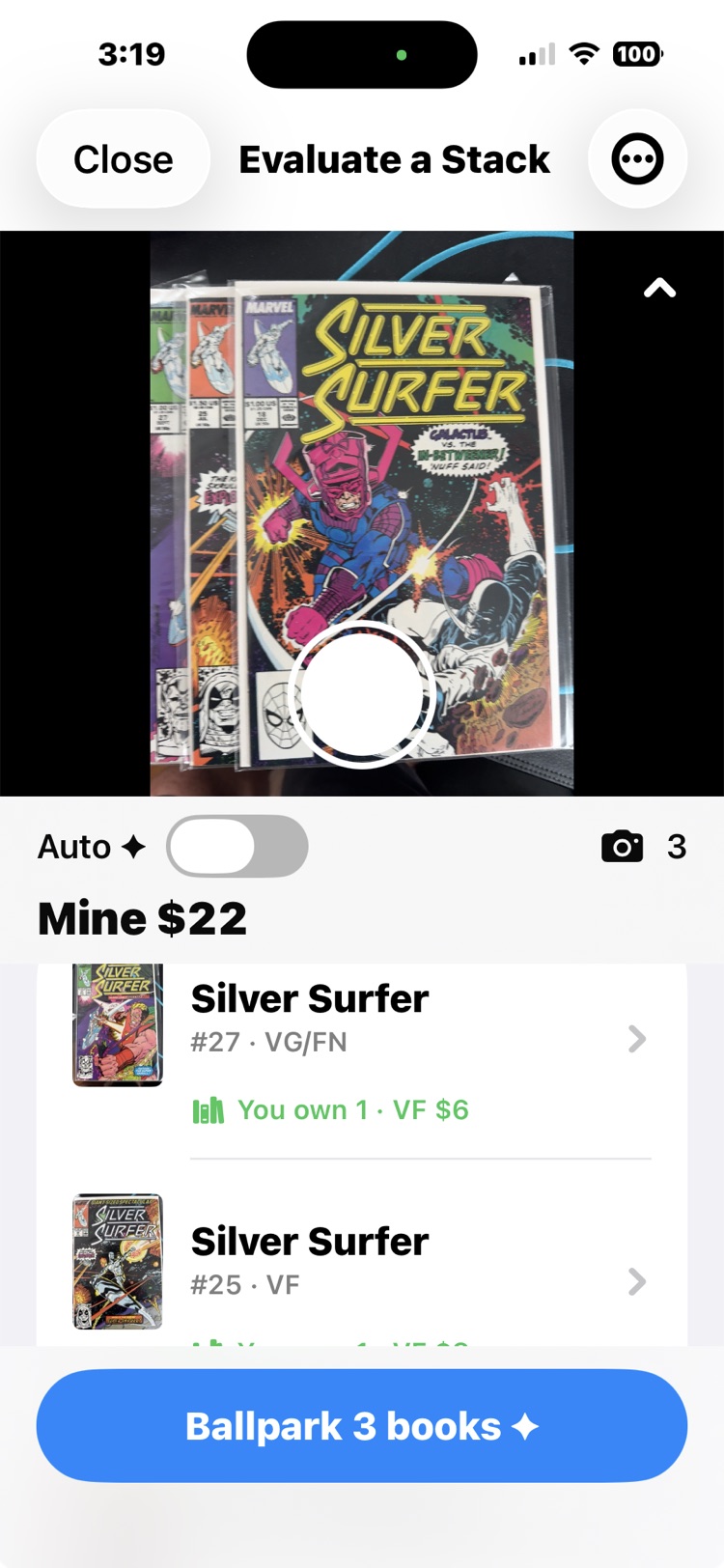
The books still in the running are the ones worth the tap. I open Evaluate a stack and photograph them, one per book, while we talk. The list builds as I go, each row filling itself in as the AI works out what the book is. Anything I want a closer look at, the row opens.
Then comes the part that actually tells me what to pay. The moment a book is identified, the app tells me whether I already own it, and shows me my copies: how many, in what condition, and what I'm asking for each one. That lands instantly, before any pricing runs, because it is just my own inventory answering. It is also the number I really negotiate from. A book I already have three of is worth less to me than a hole in a run I have been chasing. And it tells me what the person across the table may already know, because my asking price is on my own kiosk in plain sight.
It is careful about which copy it compares. If they hand me a Very Fine and mine is a Mint, that is not the same book and the app will not pretend it is. It shows me the Mint and what I want for it, then leaves it out of the running total and says so. Same with printings: my Spawn #1 is not their #1C, so the app names the printing rather than quoting one book's price against another.
Pricing is my call, and there are two ways to take it. Flip Auto ballpark on and every book prices itself the moment it is identified, which is what I want when I'm busy and there's a line. Leave it off and I get a Ballpark button instead, which prices the finished stack in one pass for a fraction of the cost. Fast or thrifty, decided fresh on every stack, and nothing is ever spent until I say so.
Either way I end up with two numbers answering two different questions: what I am already asking for the copies I own, and roughly what the market says this stack is worth. They never blend into one figure, and the first one tells me how much of the stack it actually covers, so a total across four books can't quietly be a total across two. Neither is my offer. My offer is what I decide with both of those in front of me and thirty years of doing this behind me.
Then it ends one of two ways. We shake on it, and one tap marks the books purchased and moves them into my inventory: photographed, identified, and priced from the moment they became mine. Or we don't, which is the more common ending, and one tap throws the evaluation away. Their books were never mixed into my collection to begin with.
Behind it: the ownership match is a local lookup, so it costs nothing, needs no signal, and answers while the AI is still working. Only a copy at the same condition counts toward what you're asking, because a Mint price is no guide to a Good book. Estimates are charged by the batch rather than by the book, which is why pricing a finished stack in one pass costs a fraction of pricing each book as it lands. Someone else's books stay in their own holding area, out of your collection and its searches, until you buy them.